August 20, 2026
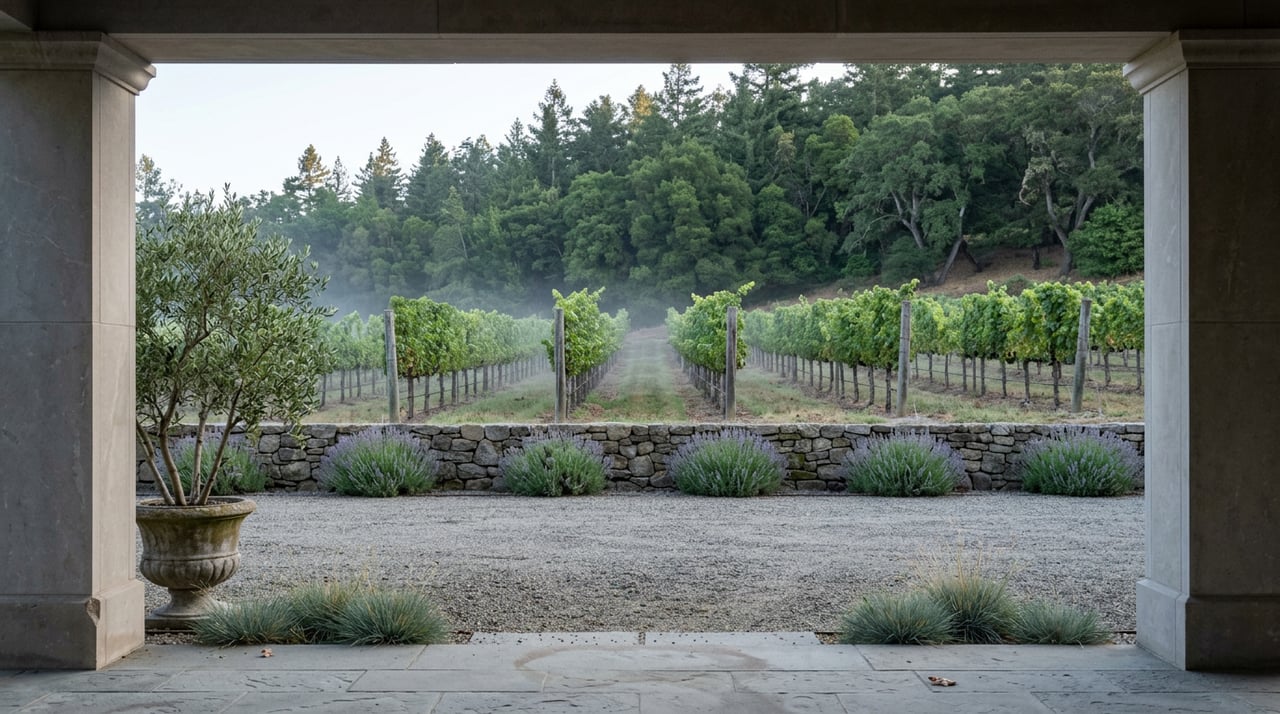
Benessere Vineyards sat on the market for roughly 18 months. Two asking prices came and went with no buyer. Then in May 2026, the 42-acre St. Helena estate, winery entitlements and residence included, went to a global online auction through Concierge Auctions in cooperation with Sotheby's International Realty. It had been listed at $28 million. Opening bids were expected between $8 million and $12 million, less than half the original ask.
That gap is not a rounding error. It's a listing telling you it has been priced as two different things for two different buyers, and only one of those buyers showed up first.
Every vineyard estate on the market in St. Helena right now carries two values stacked on top of each other. One is the dirt: the AVA designation, the soil, the water rights, the fact that this specific acreage sits inside a boundary that cannot be expanded. The other is the business built on that dirt: the case production, the wine club, the tasting room revenue, the brand equity that took decades to build.
Those two values do not move together, and 2026 is the year that gap became impossible to ignore.
A 2026 M&A guide from CT Acquisitions puts winery EBITDA multiples this year at 5.0x to 7.0x for the smallest estates, a range where land value often exceeds the going-concern value of the business itself, up to 12.0x to 16.0x for luxury direct-to-consumer brands with strong critical scores. Butterfly Equity's 2024 take-private of Duckhorn priced at roughly 15x EBITDA, anchoring the top of that range. Bogle Family Wine's acquisition of Sequoia Grove and Gallo's purchase of Denner Vineyards in Paso Robles both closed at premiums tied to estate acreage rather than case volume.
For a buyer standing in a St. Helena vineyard, that math changes what you're actually negotiating. If the estate is small and the wine business under it is thin, you may be paying almost entirely for land. If it's a scaled, critically acclaimed producer, you're paying for a brand that happens to sit on land. Confusing the two is how offers get rejected and how sellers walk away from the table feeling insulted.
Benessere wasn't an outlier. It was the clearest example of a pattern playing out across Napa Valley this year.
| Estate | What Happened in 2026 | What It Signals |
|---|---|---|
| Benessere Vineyards, St. Helena | Failed to sell at two prior asking prices over about 18 months, then went to auction with opening bids under half the original $28 million list | Going-concern value can lag land value even with winery entitlements attached |
| Rudd Estate, Oakville | Sold in April to Chanel-owned St. Supéry, ending three decades of Rudd family involvement in wine | A well-capitalized strategic buyer absorbed land and brand together, but the exit was the family's decision, not a forced sale |
| Cain Vineyards & Winery | The 46-year-old estate sold to a San Francisco investment firm in December 2025 | Institutional capital is stepping in where family operators are stepping out |
| Trinchero Family Estates | Listed the Haystack and Clouds Nest vineyards, two of its top Napa sites | Even top-tier family owners are trimming portfolios despite premium wine being comparatively insulated from the broader downturn |
Samantha Rudd's path is worth sitting with. Her father, Leslie Rudd, built Rudd Estate along with Oakville Grocery, Distillery No. 209, Press Restaurant and the Edge Hill estate before his death in 2018. She spent years winding that portfolio down one asset at a time before selling the 65-acre Oakville property itself this spring. That is not a distressed sale. It's a family choosing, deliberately and over years, which parts of a legacy to keep and which to convert to cash. The land found a buyer. The daily work of running a wine business did not hold the same appeal.
Wine Searcher data cited by industry consultant Pat Delong puts total 2026 wine and vineyard transaction volume at less than half of 2021's roughly $3.5 billion. That is the wine-business side of the ledger contracting. It says nothing about whether the acre under a neighbor's Cabernet block is worth more or less than it was five years ago.
An estate can be losing money as a wine business and still be worth more per acre than it was in 2021. Those two facts don't contradict each other. They describe two different markets sharing one parcel number.
St. Helena sits at the center of the valley floor, bordered by Rutherford, Oakville and Calistoga, all AVAs where this same land-versus-brand split is playing out. Trinchero's flagship winery and its other family vineyards, Mario's Vineyard and Central Park West, are here too, which means the town is watching one of its most established wine families actively sell rather than hold.
If you're evaluating raw vineyard acreage in the neighboring Oakville AVA rather than an operating estate, the fundamentals shift again since you're pricing dirt alone, with none of a brand's revenue history to lean on. We've broken down how to evaluate that kind of parcel on its own terms in a separate guide.
For a St. Helena estate with an existing brand, tasting room and distribution, the due diligence looks different. Before you make an offer, or before you list, get clear answers to:
None of these questions has a universally right answer. They exist so you know which of the two prices you're actually negotiating, and so a seller can price the listing to the buyer pool most likely to pay for what's really there.
Is St. Helena vineyard land still appreciating even with wineries selling below ask? The two trends can coexist. Wine-business transaction volume in 2026 is running at less than half of 2021 levels industry-wide, while land inside a recognized AVA remains a fixed, non-expandable resource. A struggling brand and appreciating dirt can sit on the same parcel.
Why did Benessere need an auction instead of a traditional sale? The property sat unsold at two prior asking prices over roughly 18 months before Concierge Auctions and Sotheby's International Realty brought it to a global auction platform in May 2026, letting bidding find the market's real ceiling rather than guessing at it through a fixed list price.
Does a family selling a winery mean the business failed? Not necessarily. Rudd Estate produced roughly 6,000 cases annually, and Samantha Rudd had already exceeded the financial benchmarks her father set for her to retain ownership. The sale to St. Supéry followed years of deliberate divestitures, not a forced exit.
What should I ask before making an offer on a St. Helena estate? Start with production records, water rights documentation, permit transferability and vineyard age. Those four answers tell you whether you're pricing land, a business, or both.
Every estate on the market in St. Helena this year is telling a version of this same story, and the only way to read it correctly is to know which line you're actually buying. The Joel Toller Team has spent nearly three decades inside these transactions, from the vineyard block to the wine business built on top of it. If you're weighing a purchase or a sale in St. Helena or anywhere across Napa Valley, schedule a confidential consultation and we'll walk the numbers with you before you make a move.
September 24, 2026
September 17, 2026

September 10, 2026
September 3, 2026
August 27, 2026
August 20, 2026
August 13, 2026
August 6, 2026
August 6, 2026
The Joel Toller Team has a comprehensive understanding of the area to help you buy and sell at the right time for the right price. Let's connect today.