
November 19, 2026
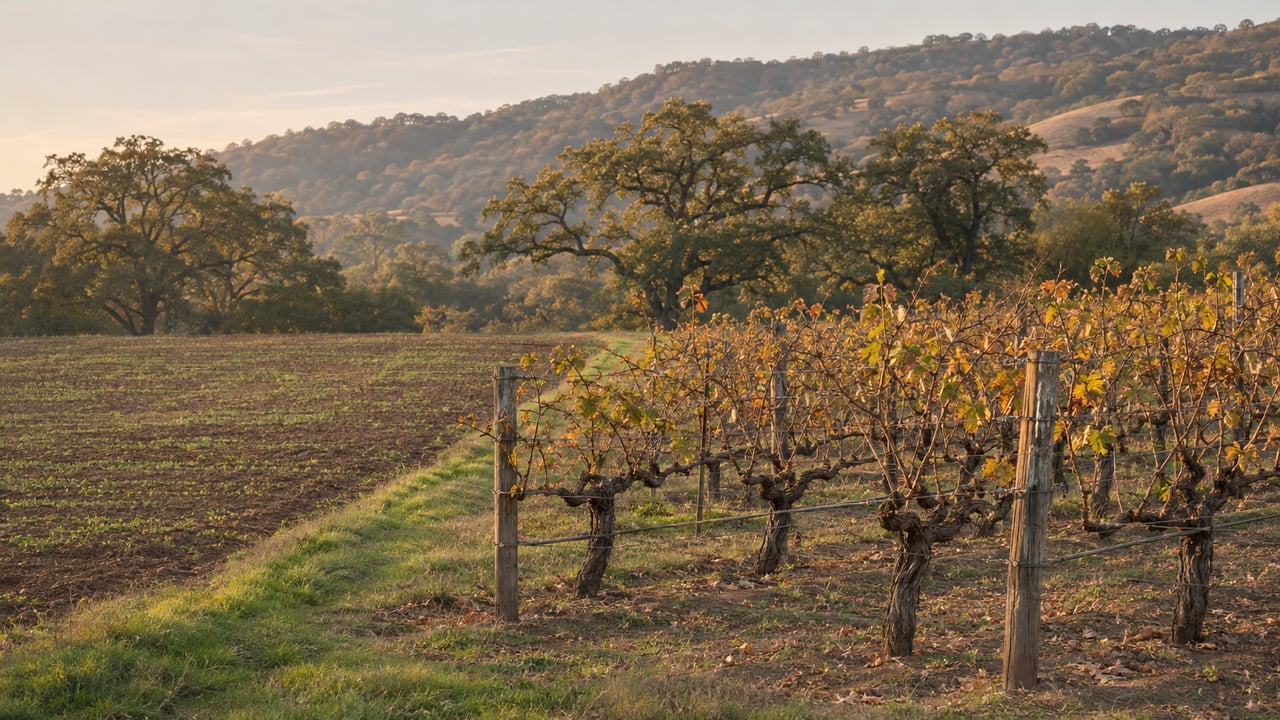
Burr clover covers most of the Rutherford valley floor. In a June 2026 Napa Valley Register report, Brian Hoefgen, who runs Beckstoffer's 300-acre Georges III Vineyard, said growers have brought in sheep that "essentially eat everything on the ground." Clover is a legume, and the three-cornered alfalfa hopper needs legumes to breed. That insect spreads red blotch, the virus that has made Rutherford a problem area in one of the most valuable growing districts in the country.
The sheep matter because of a number released this fall. Between August 1, 2025 and August 1, 2026, Rutherford removed 332 acres of vines and kept 3,315 standing, according to the 2026 California Winegrape Mapping Report that the California Association of Winegrape Growers and Land IQ released on October 15. That works out to about 10%. Napa County as a whole removed about 7% over the same period. Those removals came in the same year Rutherford growers were organizing against red blotch, and the two together mean an acre of Rutherford can be worth noticeably different amounts from one parcel to the next.
Napa held up better than California overall this year. Napa Valley Grapegrowers noted that the county's removals came to about 7% of standing acreage, against about 11% statewide, and that Napa has roughly 10% of the state's winegrape acreage but accounted for only about 6% of statewide removals. Inside the county, the picture is uneven. These are the mapping report's figures for the year ending August 1, 2026:
| Appellation | Standing acres | Acres removed | Share removed |
|---|---|---|---|
| Rutherford | 3,315 | 332 | 10.0% |
| Coombsville | 1,264 | 116 | 9.2% |
| St. Helena | 2,609 | 238 | 9.1% |
| Oak Knoll District | 3,926 | 318 | 8.1% |
| Napa Valley AVA overall | 41,864 | 2,942 | 7.0% |
| Calistoga | 2,761 | 165 | 6.0% |
| Yountville | 2,432 | 129 | 5.3% |
| Oakville | 3,500 | 176 | 5.0% |
| Howell Mountain | 1,076 | 44 | 4.1% |
| Stags Leap District | 1,296 | 25 | 1.9% |
No other Napa Valley sub-appellation with more than 1,000 standing acres removed a larger share than Rutherford. Oakville, its neighbor to the south on the same valley floor, removed half as much. Stags Leap District, just across the Silverado Trail, removed less than a fifth as much.
Two points about the method shape how to read the table. The mapping counts gross removals, so a block pulled in spring to replant next season counts the same as a block taken out of farming for good. Standing acreage also includes vines that have been mothballed or abandoned but not yet pulled. Some vineyards also sit in more than one AVA, so the appellation totals overlap. The map shows where vines came out. It cannot show why.
The Register's reporting from Rutherford explains what growers there are up against. Red blotch was identified by UC Davis researchers in 2012, and the Register described Rutherford as its center in Napa. Jake Maus of Colinas Farming Co. told the paper, "No one quite knows why Rutherford is such a hotspot for the virus." The virus disrupts how a vine moves sugar from leaf to fruit. Hoefgen said infected red varieties "look more like pink lemonade."
Timing makes the virus expensive. It can stay hidden in a vine for two or three years, so by the time red leaves show, nearby vines that look healthy may already carry it. That is why the response in Rutherford involves pulling whole sections of vines. The Register reported that Inglenook worked with UC Davis farm advisers on a protocol to map, mark and promptly remove infected vines, and that growers practice what Maus called "spatial roguing," which means pulling entire hot spots, including vines that appear healthy. Growers have also tried sheep, insecticide trials, clay "sunscreen" and hyperspectral cameras that can pick up color differences the eye misses.
Rutherford growers also coordinate. In the same Register report, Maus described a Rutherford-centered group of 10 to 15 growers that meets quarterly to time removals and replantings together, so neighbors are not "playing Ping-Pong with the virus" across the road. A 2025 CDFA research summary lists the Rutherford Neighborhood Grower Group as a collaborator on a UC Cooperative Extension project in Napa County. The project covers 11 vineyard sites and uses a handheld AI app to identify symptomatic vines and a field test that detects red blotch on site. This spring, on April 8, Napa Valley Grapegrowers held its field day "Managing Red Blotch Together" at Beckstoffer Vineyards on Conn Creek Road.
A district where growers pull whole hot spots on purpose and schedule replanting with their neighbors can be expected to show a high removal share, whatever else is behind any single block.
In the 2025 crop, Napa Cabernet Sauvignon averaged $8,645 a ton, compared with $6,690 for all Napa winegrapes, according to the county's crop report released in July 2026. The 2025 Grape Crush Report puts Napa's district Cabernet at $8,644.88 a ton, against $2,122.49 for Cabernet statewide. Valley-floor Cabernet is the crop Rutherford is known for. At those prices, replanting a block makes sense in a way it does not for growers selling into a statewide market where Cabernet earns about a quarter as much per ton.
Established Rutherford operators were also buying this year. In April 2026, the San Francisco Chronicle reported that Rutherford-based St. Supéry, owned by Chanel, acquired the 65-acre Rudd Estate in Oakville along with its Crossroads brand. The price was not disclosed.
Pulling vines in Rutherford is a capital decision. American AgCredit's appraisal team, writing in Terrain's Summer 2026 Winescape report, estimated "Napa Prime" vineyard land at $300,000 to $400,000 per acre as of May 2026, which is 10% to 30% below the 2022 to 2023 peak. That category covers well-maintained vineyards in the heart of Napa Valley and the adjacent hillsides with a history of luxury Cabernet pricing. The same report said prime Napa properties had "held their value reasonably well, though recent evidence suggests that cracks are emerging." It also said vineyards with vines near the end of their productive life in secondary areas have lost as much as 50% of peak value.
Replanting costs far less than the land. UC's cost study for Napa Cabernet, which uses June 2020 input prices and assumes a site with an existing vineyard, puts the accumulated net cash cost of establishing a new vineyard at $45,837 per acre. Today's costs will be higher than that six-year-old benchmark. The study also assumes the first harvestable crop comes in the third growing year. In the Register's account, removing vines, fallowing the ground and replanting means giving up several years of revenue from some of the county's most valuable acreage while labor, materials and debt service continue.
On land appraised in the hundreds of thousands per acre, the larger cost of a red blotch replant is the lost crop, not the new vines. A buyer who pays the prime rate for a block that will need replanting in two years is paying for revenue that will not arrive on schedule. A buyer of a block replanted last season with clean stock is paying full appellation value during a stretch with no crop, but for vines at the start of their productive life.
This is the main point for anyone comparing Rutherford parcels this winter. The appellation name, the soils and the address on Highway 29 or Conn Creek Road can match while the vines sit at very different points in a reset. One parcel has mature vines with no sign of the virus. Another has a block that was rogued last harvest. A third was fallowed and replanted this year. The Terrain range describes the prime segment as a whole, and the spread inside it is where Rutherford parcels now differ most.
Where a parcel stands in that cycle starts with when each block was planted and where the plant material came from. Napa Valley Grapegrowers notes that infected propagation material can bring the virus in when vines are not sourced through certified-clean programs. Foundation Plant Services at UC Davis is the primary source of certified, virus-tested grapevines distributed through California's Grapevine Registration and Certification Program. The block-by-block removal history over the past few vintages fills in the rest, along with where the neighboring parcels fall on the shared replant calendar, since the virus does not stop at fence lines and Rutherford growers plan their replanting around the parcels next door.
Our earlier pieces on Rutherford estate and vineyard basics, evaluating Oakville AVA acreage and the land and brand prices inside St. Helena vineyard listings cover the wider diligence. Vine stage is the part that changed most in Rutherford this year.
Is Rutherford losing vineyard acreage for good? The mapping report counts gross removals for the year ending August 1, 2026, which can include blocks cleared for replanting. Rutherford still had 3,315 standing acres at the end of that period.
Does red blotch affect only Rutherford? No. Rutherford is the center of the problem in the Register's reporting, but the virus is spread by an insect and through infected plant material, and as Maus put it, "Insects and viruses don't respect lines we draw on a map."
How long before a replanted block produces again? UC's Napa Cabernet cost study, based on 2020 inputs, assumes the first harvestable crop in the third growing year.
The values and costs in this post are general market information, not financial or tax advice, so confirm the figures for your own situation with your own advisors.
If you are comparing Rutherford parcels and want to know where each block sits in its replant cycle before you discuss price, The Joel Toller Team would welcome the conversation. Schedule a Confidential Consultation, and see our Rutherford neighborhood page for the valley floor we know best.
November 19, 2026

November 12, 2026

November 5, 2026

October 29, 2026

October 22, 2026

October 15, 2026

October 8, 2026
October 1, 2026
September 24, 2026
The Joel Toller Team has a comprehensive understanding of the area to help you buy and sell at the right time for the right price. Let's connect today.